
- Home
- Health Center
- Health Info
- Building Strong Bones for Growing Kids
Building Strong Bones for Growing Kids
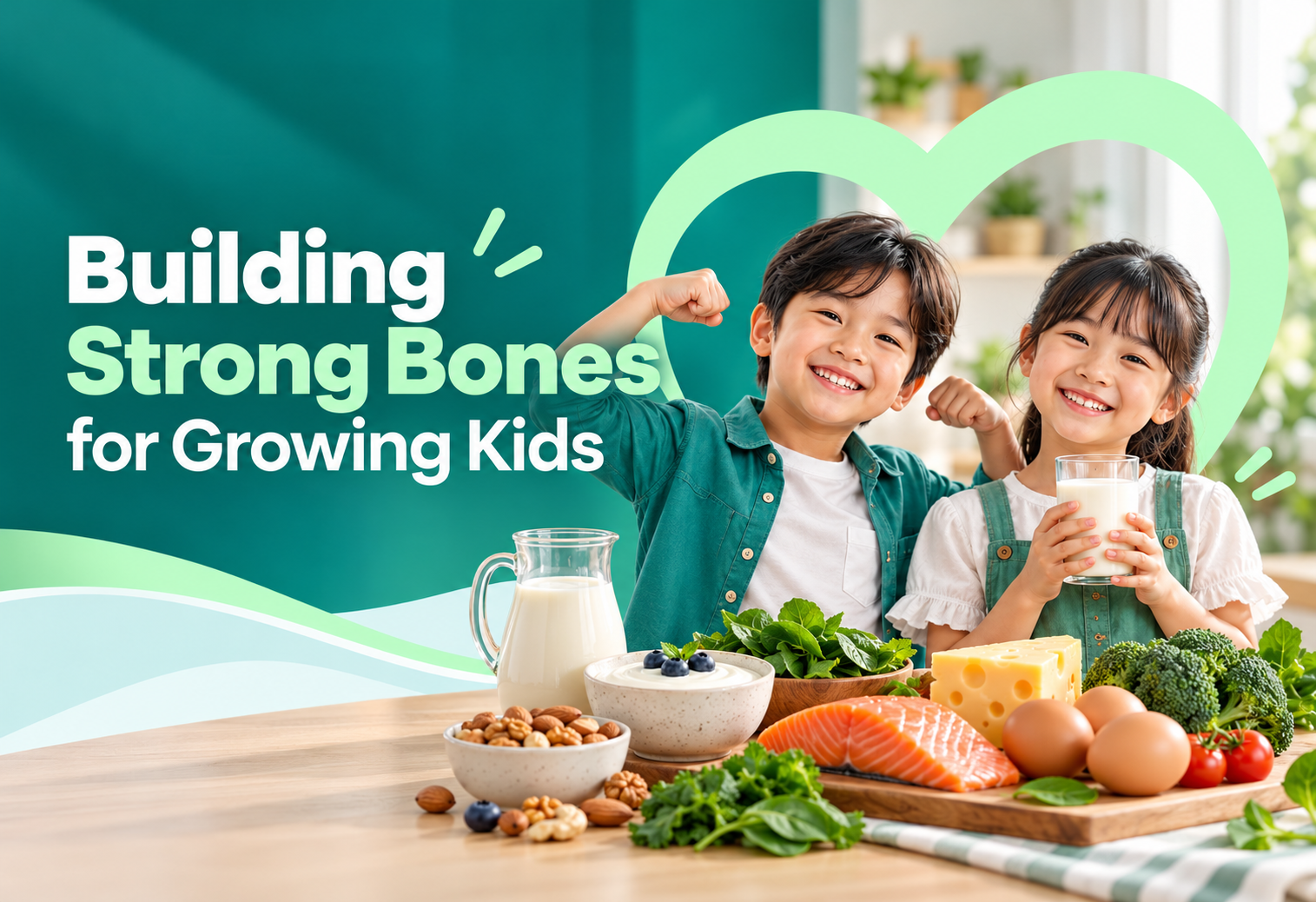
Childhood and adolescence are critical periods for building the bone mass and strength that support skeletal health into adulthood. The strongest foundation comes from a combination of calcium-rich foods, adequate vitamin D, balanced nutrition and regular weight-bearing activity such as running, jumping and dancing. [1, 2, 3, 4]
Bones are living tissues that constantly break down and rebuild. During growth, the body needs enough energy, protein, minerals and vitamins to form a strong skeleton. Childhood and adolescence are especially important because healthy bone-building during these years helps children reach a higher peak bone mass, which may lower the risk of fragile bones later in life. [1, 3, 5, 6]
The good news is that bone health does not depend on one “superfood” or one supplement. Everyday habits—what children eat, how active they are and whether they get enough vitamin D—work together over time. [1, 4, 6]
Why is bone health so important during childhood?
Bone tissue grows rapidly throughout childhood, with particularly important gains around puberty and adolescence. If a child consistently falls short on bone-building nutrients or is very inactive, the body may have less opportunity to build and strengthen bone during this high-growth period. [1, 3]
Strong bones do more than reduce fracture risk. They support movement, protect internal organs and provide the framework that allows children to run, jump and play confidently. Building healthy habits early can also make it easier to maintain bone health into adulthood. [1, 5]
Which nutrients help children build strong bones?
| Nutrient | Why it matters | Family-friendly food sources |
|---|---|---|
| Calcium | Provides a major mineral component of bones and teeth. | Milk, yogurt, cheese, calcium-fortified plant drinks, calcium-set tofu, selected leafy green vegetables, sesame products and canned fish with soft edible bones. [5, 6, 7, 8, 9] |
| Vitamin D | Helps the body absorb and use calcium and phosphorus effectively. | Oily fish, egg yolk and fortified foods. Vitamin D is also made in the skin with sunlight exposure. [2, 10, 11, 12] |
| Protein | Supports growth and provides building blocks for bone matrix and muscle. | Fish, chicken, eggs, milk, yogurt, tofu, tempeh, beans and lentils. [3, 5] |
| Magnesium & phosphorus | Contribute to normal bone structure and mineralisation. | Whole grains, legumes, nuts/seeds, dairy, fish and many protein foods. [6, 13] |
How can parents add more calcium to everyday meals?
Dairy products can contribute calcium, protein and phosphorus to children's diets, and studies have examined their role in supporting bone mineral development during growth. [6, 7]
Children who consume little or no dairy can still get calcium from other foods. Useful options include calcium-fortified plant drinks, calcium-set tofu, beans and lentils, leafy green vegetables, sesame seeds and canned fish with soft edible bones. Check labels because the calcium content of fortified foods can vary. [5, 8, 9]
How much calcium does my child need?
Recommended calcium intake generally increases as children grow. According to the Malaysian Recommended Nutrient Intakes (RNI) 2017, the recommended daily calcium intake is: [8]
| Age | Recommended calcium intake |
|---|---|
| 1–3 years | 700 mg/day |
| 4–9 years | 1,000 mg/day |
| 10–18 years | 1,300 mg/day |
These values refer to total daily calcium intake from food and, where necessary, supplements—not the amount that should be taken as a supplement. Most children should aim to meet their calcium needs primarily through food, with supplementation considered when dietary intake is inadequate or when advised by a healthcare professional.
The Malaysian RNI also notes that these recommendations are intended for healthy populations and may not meet the specific requirements of people with particular diseases or conditions.
Easy meal and snack ideas
- Milk or a calcium-fortified alternative with breakfast.
- Yogurt with fruit, oats or whole-grain cereal.
- Cheese cubes with fruit or vegetable sticks in a lunchbox.
- A smoothie made with milk or a fortified plant drink plus fruit.
- Tofu, beans or lentils added to rice dishes, soups, noodles or wraps.
- Leafy greens added to omelettes, pasta, soup or stir-fries.
These small swaps can make bone-building foods part of normal family routines without turning meals into a daily nutrition project. [5, 9, 13, 14]
Why is vitamin D important for children's bones?
Vitamin D helps the gut absorb calcium and supports normal mineralisation of growing bone. When vitamin D is too low, the body may not use calcium efficiently, even when calcium is present in the diet. Severe deficiency can contribute to rickets, a condition in which growing bones become soft and weak. [2, 10, 11, 12]
Food sources include oily fish, egg yolk and vitamin D-fortified foods. Vitamin D can also be produced in the skin following sunlight exposure. However, intentional excessive sun exposure is not recommended, and appropriate sun-safety practices should still be followed.
Children who have limited dietary intake, very little sun exposure or other risk factors may need individual assessment rather than automatic supplementation. Ask a doctor or pharmacist before giving a child a vitamin D or calcium supplement, especially if the child has a medical condition or takes regular medicines. [2, 8, 10, 12]
What type of exercise makes bones stronger?
Bones respond to healthy mechanical loading. Weight-bearing and impact activities—such as running, jumping, hopping, dancing, skipping and many playground games—place controlled stress on the skeleton and help stimulate bone development. [1, 4, 16]
For children and adolescents aged 5–17 years, aim for an average of at least 60 minutes of moderate- to vigorous-intensity physical activity each day. This can include active play, sports, walking, cycling and other age-appropriate activities.
Vigorous-intensity activities, including those that strengthen muscles and bones, should be included at least 3 days a week. Adequate nutrition and regular physical activity work together to support healthy bone development during growth. [1, 4, 16]
5 simple habits that support strong bones in kids
When should parents ask a healthcare professional for advice?
Speak with a doctor or paediatrician if a child has repeated fractures, persistent or unexplained bone pain, or concerns about growth. A doctor, dietitian or pharmacist can also advise if the child's diet is very restricted or there are concerns about calcium or vitamin D intake. [8, 10, 12, 15]
The bottom line
Strong bones are built gradually. A child does not need a perfect diet every day; what matters is a consistent pattern of calcium-rich foods, adequate vitamin D, balanced nutrition and regular weight-bearing activity. By making these habits part of family life, parents and caregivers can help children build a stronger skeletal foundation for the years ahead. [1, 3, 4, 5]
Speak with a CARiNG pharmacist
Need personalised advice about your child's nutrition or supplement needs? Speak with a CARiNG pharmacist about your child's diet, calcium and vitamin D intake, and whether supplementation may be appropriate.
Important: Supplement choice and dose for children should be appropriate for age, diet and health needs. Ask a pharmacist or doctor if you are unsure.
Find your nearest CARiNG Pharmacy →Medical disclaimer: This article is for general health education and is not a substitute for medical advice, diagnosis or treatment. Nutrient and supplement needs vary by age, diet and health status. Seek advice from a qualified healthcare professional if you have concerns about your child's growth, bone health or supplement use.
Frequently asked questions about strong bones in children
What is the best nutrient for strong bones in children?
Do children need calcium supplements?
Does vitamin D help children grow strong bones?
What foods are high in calcium for children who do not drink milk?
What exercises are best for children's bones?
Can picky eaters still get enough bone-building nutrients?
View references 16 sources
- Proia P, Amato A, Drid P, Korovljev D, Vasto S, Baldassano S. The impact of diet and physical activity on bone health in children and adolescents. Front Endocrinol (Lausanne). 2021;12:704647. doi:10.3389/fendo.2021.704647. Source
- Moreno MA, Furtner F, Rivara FP. Vitamin D and bone health. Arch Pediatr Adolesc Med. 2012;166(7):684. doi:10.1001/archpediatrics.2012.1066. Source
- Prentice A, Schoenmakers I, Laskey MA, de Bono S, Ginty F, Goldberg GR. Nutrition and bone growth and development. Proc Nutr Soc. 2006;65(4):348-360. doi:10.1017/S0029665106005192. Source
- Christopoulos M, Klentrou P. Exercise and nutrition for building strong bones. Front Young Minds. 2025;13:1494421. doi:10.3389/frym.2025.1494421. Source
- Redondo-Cuevas L, Sanchis-Chordà J, Codoñer-Franch P. Child nutrition and bone health. J Child Sci. 2018;8(1):e67-e74. doi:10.1055/s-0038-1669402. Source
- Cuadrado-Soto E, López-Sobaler AM, Jiménez-Ortega AI, Aparicio A, Bermejo LM, Hernández-Ruiz Á, et al. Usual dietary intake, nutritional adequacy and food sources of calcium, phosphorus, magnesium and vitamin D of Spanish children aged one to <10 years: findings from the EsNuPI study. Nutrients. 2020;12(6):1787. doi:10.3390/nu12061787. Source
- de Lamas C, de Castro MJ, Gil-Campos M, Gil Á, Couce ML, Leis R. Effects of dairy product consumption on height and bone mineral content in children: a systematic review of controlled trials. Adv Nutr. 2019;10(Suppl 2):S88-S96. doi:10.1093/advances/nmy096. Source
- National Coordinating Committee on Food and Nutrition. Recommended nutrient intakes for Malaysia: a report of the Technical Working Group on Nutritional Guidelines. Putrajaya: Ministry of Health Malaysia; 2017 [cited 2026 Sep 18]. Source
- National Institutes of Health, Office of Dietary Supplements. Calcium: fact sheet for consumers. Bethesda (MD): National Institutes of Health; [cited 2026 Sep 18]. Source
- Nadar R, Uday S. A clinician's guide to vitamin D and bone health in children. Paediatr Child Health. 2021;31(9):364-370. doi:10.1016/j.paed.2021.06.006. Source
- Karimian P, Khoshnezhad Ebrahimi H, Jafarnejad S, Aghajani Delavar M. Effects of vitamin D on bone density in healthy children: a systematic review. J Family Med Prim Care. 2022;11(3):870-878. doi:10.4103/jfmpc.jfmpc_2411_20. Source
- National Institutes of Health, Office of Dietary Supplements. Vitamin D: fact sheet for consumers. Bethesda (MD): National Institutes of Health; [cited 2026 Sep 18]. Source
- Abrams SA. Bone health in school-age children: effects of nutritional intake on outcomes. Front Nutr. 2021;8:773425. doi:10.3389/fnut.2021.773425. Source
- Lo HWH, Zhang F, Mahajan A, Darlington G, Duncan AM, Haines J, et al. Dietary intake and food sources of calcium and vitamin D in young children in the Guelph Family Health Study. Int Dairy J. 2024;156:105980. doi:10.1016/j.idairyj.2024.105980. Source
- Ward LM. A practical guide to the diagnosis and management of osteoporosis in childhood and adolescence. Front Endocrinol (Lausanne). 2024;14:1266986. doi:10.3389/fendo.2023.1266986. Source
- World Health Organization. WHO guidelines on physical activity and sedentary behaviour. Geneva: World Health Organization; 2020 [cited 2026 Sep 18]. Source
Related Health Info
Latest Health Info
Building Strong Bones for Growing Kids
Quick answer Childhood and adolescence are critical periods for building the bone mass and strength that support skeletal health into ...

From Growth to Immunity: The Importance of Proper Nutrition in Teenage Health
The short answer The teenage years are a period of rapid growth and development, making good nutrition especially important. Teenagers ...

Bone Health: Understanding the Role of Supplements
The short answer Think strong bones are simply about getting enough calcium? Think again. Bone health depends on much more ...