
- Home
- Health Center
- Health Info
- Role of Vitamin D and Calcium in Elderly Fall Prevention
Ageing
Role of Vitamin D and Calcium in Elderly Fall Prevention
Written By Ms. Ng Tzi Jia
Registered Pharmacist
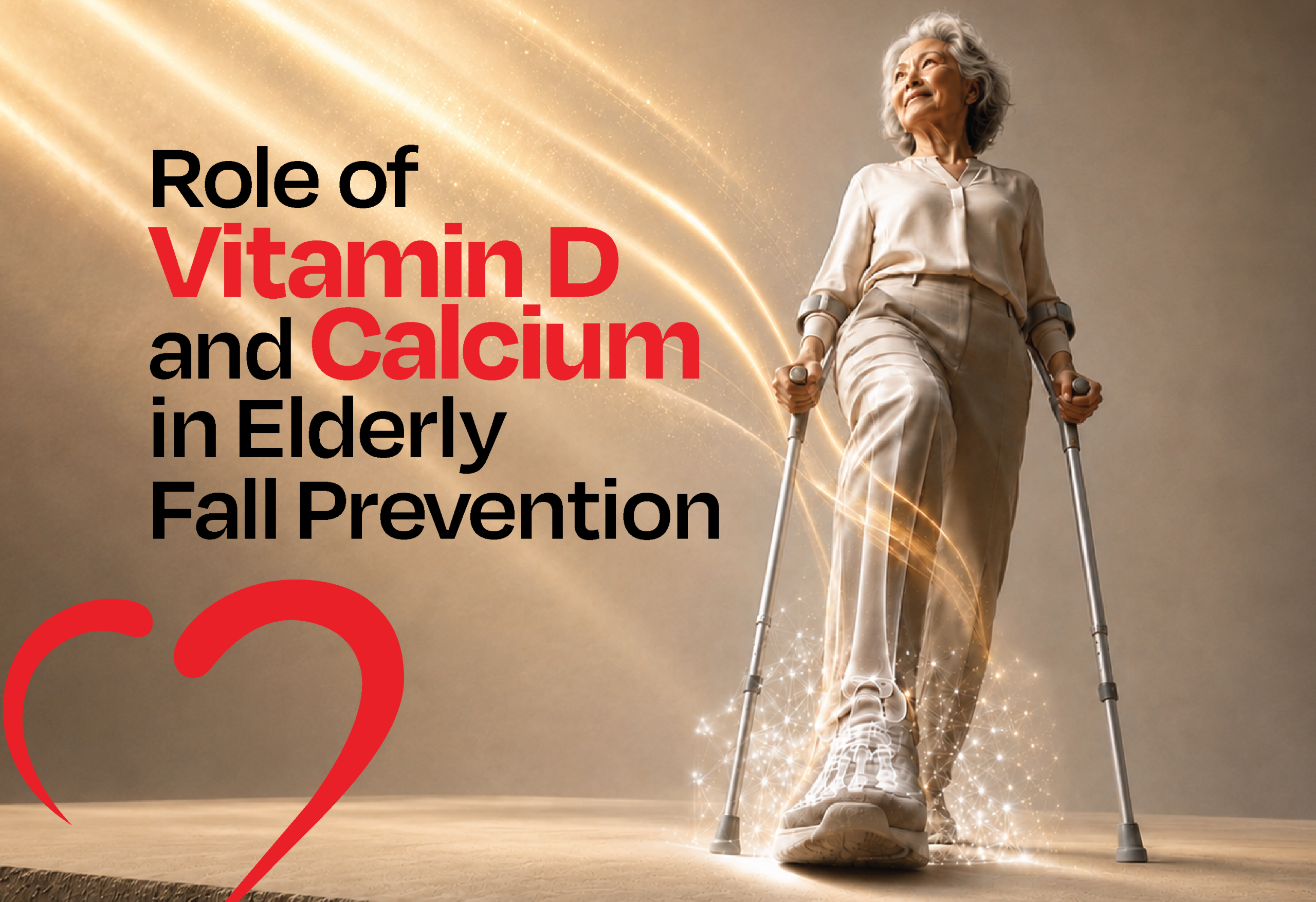
Vitamin D and calcium are important for bone health, while vitamin D also supports muscle function. Supplements may be useful for selected older adults, especially when vitamin D deficiency or low intake is present, but they are not a stand-alone way to prevent every fall. Strength and balance exercise, together with a review of medicines, vision and home hazards, remains essential. [1–8]
Falls become more common with age and can lead to injury, fractures, hospitalisation and loss of independence. Strong bones matter because they can reduce the consequences of a fall, while muscle strength, balance, visual acuity, reviewing the use of medicines and the home environment all influence whether a fall happens. [7, 8]
Article Highlights
Vitamin D
Helps the body absorb calcium and contributes to normal muscle and bone function.
Calcium
A major mineral in bones and teeth. Adequate intake supports bone strength.
Supplements
Most useful when they address a real need, such as low intake, vitamin D deficiency or a clinician-identified fracture risk.
Fall prevention
Exercise that trains balance, gait and strength, plus action on individual fall risks, has the clearest role in preventing falls.
Why Are Falls a Concern in Older Adults?
Ageing can bring changes in muscle strength, balance, vision, reaction time and bone density. Some health conditions and medicines can also contribute to dizziness, weakness or unsteadiness. If bones are fragile because of osteoporosis, a fall is more likely to result in a fracture. [7, 8]
Malaysia’s osteoporosis guideline recommends that adults aged 65 years and above be screened at least once a year for falls, how often they fall, and problems with gait or balance. People who screen positive should receive a more detailed assessment and an individualised plan. [9]
How Do Vitamin D and Calcium Support Bone and Muscle Health?
Calcium provides much of the mineral structure that gives bones strength. Vitamin D helps the body absorb calcium efficiently. Together, adequate intake supports bone maintenance as people age. [1, 3, 5, 6]
Vitamin D is also linked with muscle function. Earlier studies observed that low vitamin D status was associated with muscle weakness and a higher risk of falling, and some trials reported improvements after supplementation in deficient or higher-risk older adults. [2–6]
Do Vitamin D and Calcium Supplements Actually Prevent Falls?
Vitamin D should not be treated as a universal fall-prevention supplement, but it can still be appropriate when deficiency is present or likely, or when it forms part of osteoporosis or fracture-risk management. [9–10] Other than just vitamin D supplementation, a more holistic approach such as improving muscle strength, balance, visual acuity, medication reviews and a safe home environment matters. [7, 8]
Who May Benefit Most From Vitamin D or Calcium Supplementation?
A healthcare professional may consider supplementation when an older adult has one or more of the following: [9–10]
- known vitamin D deficiency or a high likelihood of deficiency
- low dietary calcium or vitamin D intake
- osteoporosis, a previous fragility fracture or another reason for high fracture risk
- a care-home or very frail setting where vitamin D deficiency is more common
- a need for calcium and vitamin D alongside prescribed osteoporosis treatment
- a medical condition that affects nutrient absorption or bone health
How Much Vitamin D and Calcium Do Older Adults Need in Malaysia?
For generally healthy older adults, the Malaysian Clinical Practice Guidelines for Management of Osteoporosis list the following recommended nutrient intakes (RNI): [9]
| Older adult group | Calcium | Vitamin D |
|---|---|---|
| Men over 65 | 1,000 mg/day | 20 µg (800 IU)/day |
| Women over 65 | 1,200 mg/day | 20 µg (800 IU)/day |
These figures refer to overall daily intake, including food and supplements. A supplement should usually fill the gap between dietary intake and the amount needed, rather than automatically adding the full RNI on top of food.
For people over 50 who are at risk of fractures, particularly when starting active osteoporosis therapy, the Malaysian guideline recommends at least 800 IU/day of vitamin D together with 1,200 mg/day of elemental calcium as part of clinical management. This is different from giving the same supplement dose to every older adult. [9]
What Are Good Food Sources of Calcium and Vitamin D?
Food is a practical starting point for meeting nutrient needs. Examples include: [12–13]
Calcium-rich foods
- milk, yoghurt and cheese;
- calcium-fortified tofu and some soy products;
- certain vegetables (e.g., kale, broccoli, Chinese cabbage);
- sardines or other fish eaten with the soft bones; and
- calcium-fortified foods or drinks.
Vitamin D sources
- flesh of fatty fish such as salmon, sardines and mackerel;
- fish liver oils;
- cheese;
- egg yolk; and
- foods or drinks fortified with vitamin D.
Sunlight also contributes to vitamin D production in the skin. However, age, time spent indoors, clothing, skin pigmentation and other factors can affect vitamin D status, so some people may still need dietary or supplemental support. [12]
Can Too Much Vitamin D or Calcium Be Harmful?
Yes. More is not always better. Current guidance focuses more on avoiding unnecessary high-dose or intermittent megadose regimens and using an appropriate dose for the person’s actual need. [12, 14]
For adults aged 50 years and above who have an indication for vitamin D treatment or supplementation, the Endocrine Society suggests a daily, lower-dose approach rather than non-daily high-dose vitamin D. The U.S. adult tolerable upper intake level is 4,000 IU/day for vitamin D, but an upper limit is a safety ceiling, not a target dose. [12, 14]
Safety reminder: Excessive vitamin D intake may cause high calcium levels in the body. High supplemental calcium can cause gastrointestinal side effects in some people and may increase kidney-stone risk. Calcium and vitamin D supplements can also interact with medicines. Older adults who take regular medicines, have kidney disease, have had kidney stones or are already using several supplements should check with a healthcare professional before adding more. [12, 13]
What Else Helps Reduce Fall Risk?
Nutrition is only one part of fall prevention. The Malaysian guideline and the 2024 USPSTF recommendation place strong emphasis on exercise and individualised risk reduction. [9, 11]
- Exercise for balance and strength: programmes often include gait, balance, functional and resistance training. Choose activities that match the person’s ability and health conditions. [9, 11]
- Medication review: some medicines can contribute to drowsiness, dizziness or low blood pressure. Do not stop medicines on your own; ask a healthcare professional to review them. [7, 9]
- Home safety: improve lighting, remove loose rugs or clutter, address slippery floors and consider grab rails where appropriate. [9]
- Vision and footwear: keep vision checks up to date and wear well-fitting, supportive shoes. [8, 9]
- Check for dizziness on standing: dehydration, blood-pressure changes and some medicines can contribute to unsteadiness. [9]
- Seek assessment after a fall: repeated falls, new balance problems or a fall-related injury deserve medical review. [9]
Key Takeaway
Vitamin D and calcium help maintain bone health, and correcting vitamin D deficiency may be appropriate for older adults. But the best fall-prevention plan does more than add a supplement: it combines adequate nutrition with strength and balance exercise and action on individual risks such as medicines, vision and home hazards. [9–11]
Talk to a CARiNG Pharmacist
Want to learn more about vitamin D or calcium intake, supplements or fall-risk factors?
Medical disclaimer: This article is for general health education and is not a substitute for medical advice, diagnosis or treatment. Supplement needs can differ with diet, medicines, kidney function, osteoporosis treatment and other health conditions. Seek advice from a qualified healthcare professional for personal recommendations.
Frequently Asked Questions
Does vitamin D prevent falls in older adults?
How much vitamin D does an older adult need in Malaysia?
The Malaysian RNI for adults over 65 is 800 IU of vitamin D per day. Individual treatment doses can differ when deficiency or another medical indication is present. [9]
How much calcium does an older adult need?
The Malaysian RNI is 1,000 mg/day for men over 65 and 1,200 mg/day for women over 65, from food plus supplements if needed. [9]
Should vitamin D and calcium be taken together?
Can high-dose vitamin D increase fall risk?
What is the most effective way to reduce falls?
View references 14 sources
- Tan L, He R, Zheng X. Effect of vitamin D, calcium, or combined supplementation on fall prevention: a systematic review and updated network meta-analysis. BMC Geriatr. 2024;24:390. doi:10.1186/s12877-024-05009-x. Source
- Wei F, Li T, Gao Q, Huang Y, Zhou C, Wang W, Qian J. Association between vitamin D supplementation and fall prevention. Front Endocrinol (Lausanne). 2022;13:919839. doi:10.3389/fendo.2022.919839. Source
- Annweiler C, Montero-Odasso M, Schott AM, Berrut G, Fantino B, Beauchet O. Fall prevention and vitamin D in the elderly: an overview of the key role of the non-bone effects. J Neuroeng Rehabil. 2010;7:50. doi:10.1186/1743-0003-7-50. Source
- Ling Y, Xu F, Xia X, Dai D, Xiong A, Sun R, et al. Vitamin D supplementation reduces the risk of fall in the vitamin D deficient elderly: an updated meta-analysis. Clin Nutr. 2021;40(11):5531-5537. doi:10.1016/j.clnu.2021.09.031. Source
- Pfeifer M, Begerow B, Minne H, Suppan K, Fahrleitner-Pammer A, Dobnig H. Effects of long-term vitamin D and calcium supplementation on falls and parameters of muscle function in community-dwelling older individuals. Osteoporos Int. 2009;20:315-322. doi:10.1007/s00198-008-0662-7. Source
- Bischoff HA, Stähelin HB, Dick W, Akos R, Knecht M, Salis C, et al. Effects of vitamin D and calcium supplementation on falls: a randomized controlled trial. J Bone Miner Res. 2003;18(2):343-351. doi:10.1359/jbmr.2003.18.2.343. Source
- Ming Y, Zecevic AA, Hunter SW, Miao W, Tirona RG. Medication review in preventing older adults’ fall-related injury: a systematic review and meta-analysis. Can Geriatr J. 2021;24(3):237-250. doi:10.5770/cgj.24.478. Source
- Wieczorek M, Isler M, Landau K, Becker MD, Dawson-Hughes B, Kressig RW, et al. Association between visual acuity and prospective fall risk. J Am Med Dir Assoc. 2024;25(5):789-795.e2. doi:10.1016/j.jamda.2024.03.005. Source
- Ministry of Health Malaysia, Malaysian Osteoporosis Society, Academy of Medicine Malaysia. Clinical Practice Guidelines: Management of Osteoporosis. 3rd ed. 2022. Source
- Montero-Odasso M, van der Velde N, Martin FC, et al. World guidelines for falls prevention and management for older adults: a global initiative. Age Ageing. 2022;51(9):afac205. doi:10.1093/ageing/afac205. Source
- US Preventive Services Task Force. Falls Prevention in Community-Dwelling Older Adults: Interventions. Final recommendation. June 4, 2024. Source
- National Institutes of Health, Office of Dietary Supplements. Vitamin D – Health Professional Fact Sheet. Updated 2025. Source
- National Institutes of Health, Office of Dietary Supplements. Calcium – Health Professional Fact Sheet. Updated 2025. Source
- Demay MB, Pittas AG, Bikle DD, et al. Vitamin D for the Prevention of Disease: An Endocrine Society Clinical Practice Guideline. J Clin Endocrinol Metab. 2024;109(8):1907-1947. doi:10.1210/clinem/dgae290. Source
Latest Health Info

Malaysia Haze & Air Quality Index (AQI) Today
Is the air safe where you are? Check Malaysia’s latest haze readings, find the nearest monitoring location and get practical ...

Eczema in Children: Nutrients That May Help Soothe Symptoms
The short answer Good nutrition supports a child’s overall health, but emollients, gentle skin care and prescribed treatment remain essential ...

Smoking and Skin Ageing: Why Cigarettes Cause Wrinkles and Sagging
The short answer Yes. Cigarette smoking can accelerate skin ageing, contributing to premature wrinkles, uneven skin tone and loss of ...