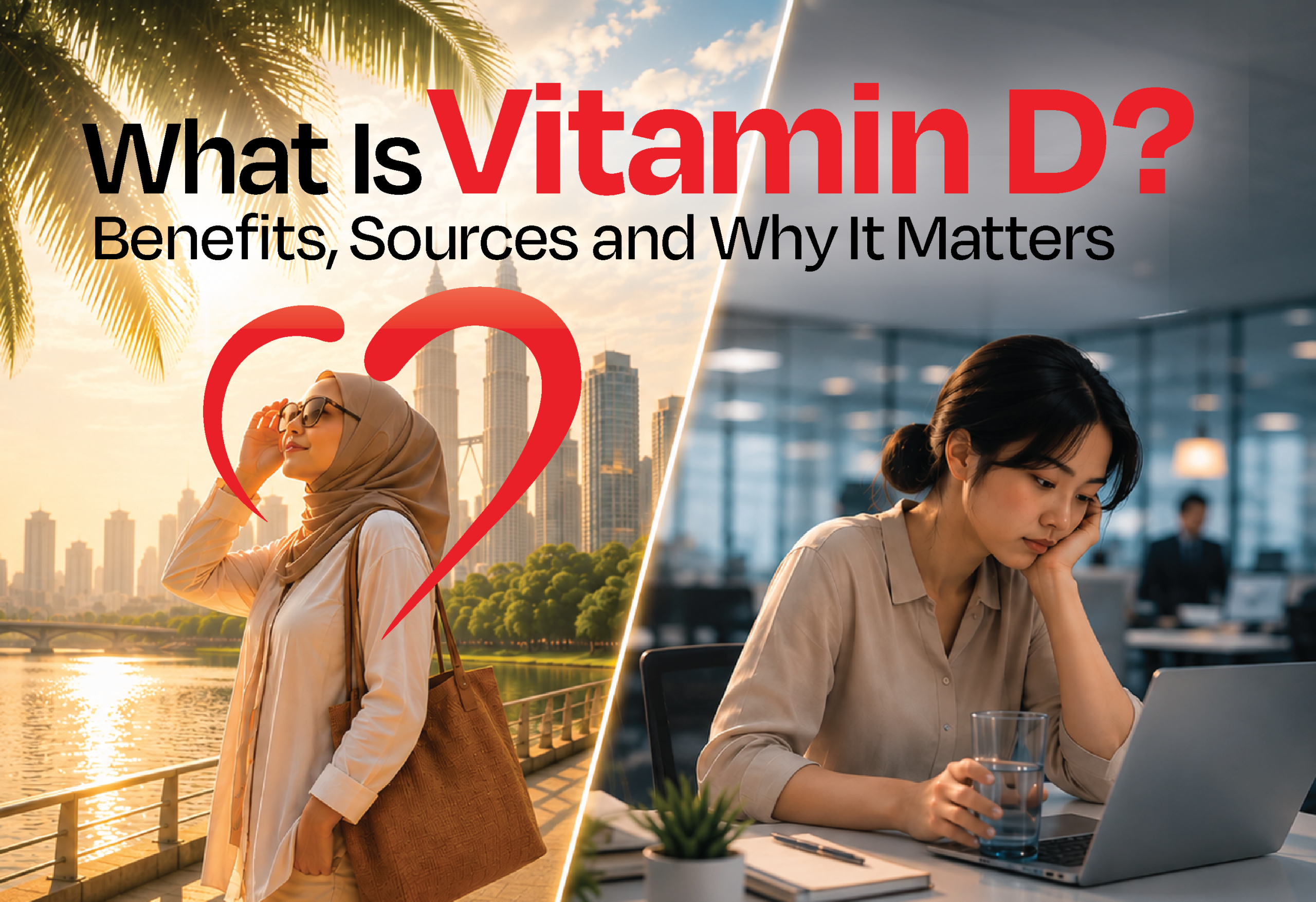
Vitamin D is a fat-soluble vitamin that helps the body absorb calcium and phosphorus, supporting healthy bones and teeth as well as normal muscle function. Your body can make vitamin D when skin is exposed to UVB sunlight, and you can also get it from food and supplements. Severe deficiency can cause rickets in children and osteomalacia in adults. [1, 5, 6, 10]
Often called the “sunshine vitamin”, vitamin D is unusual because food is not its only source. Sunlight can trigger vitamin D production in the skin, while certain foods and supplements can help contribute to your intake. [1–3, 10]
The important point is balance: too little vitamin D can affect bone health, but taking more is not automatically better. Your needs depend on factors such as age, sun exposure, diet and health conditions. [10–12]
What does vitamin D do in the body?
01
Helps maintain strong bones and teeth
Vitamin D helps the body absorb calcium and phosphorus, minerals that are essential for bone mineralisation and healthy teeth. Long-term deficiency can weaken bones. [5, 6, 10]
02
Supports normal muscle function
Vitamin D is involved in muscle function. Low vitamin D status has been associated with poorer physical performance and muscle weakness, especially in older adults. [8, 10]
03
Plays a role in immune function
Vitamin D is involved in immune function. Supplementation may reduce respiratory infection risk in certain groups. However, vitamin D should not be viewed as a guaranteed way to prevent colds or flu. [7, 11]
04
May be linked with mental well-being
Low Vitamin D levels may affect one’s mood – thus, keeping your Vitamin D levels in check might just be one way to help support your mental well-being. [9]
Where can you get vitamin D?
There are three main ways to get vitamin D: sunlight, food and supplements.
Source
What to know
Examples / notes
Sunlight
UVB exposure to the skin can trigger vitamin D production. There is no single
number of minutes that suits everyone because production varies with skin
pigmentation, age, time of day, cloud cover, clothing, sunscreen and location.
Malaysia is near the equator, but individual sun exposure still varies.
[2, 10, 12]
Food
Only a limited number of foods naturally contain much vitamin D, so fortified
foods can be helpful. Check the nutrition label because fortification differs
by product.
Oily fish such as salmon, sardines and mackerel; egg yolks; fortified milk,
cereals and other foods.
[3, 10]
Supplements
Supplements may be useful when food and sunlight are not enough or when a
healthcare professional recommends them. The right amount depends on the person.
Ask a healthcare professional if you are unsure which product or dose is appropriate.
[4, 10, 11]
Who may be at risk of vitamin D deficiency?
Vitamin D deficiency can affect anyone, but risk may be higher in people who: [10]
spend very little time outdoors or keep most of their skin covered when outside
have darker skin tones, because higher melanin levels reduce the skin’s vitamin D
production from UVB
are older, because the skin becomes less efficient at producing vitamin D with age
have conditions that reduce fat absorption, such as certain gastrointestinal disorders
or after some types of bariatric surgery
have obesity, which can be associated with lower circulating vitamin D levels
have certain liver or kidney conditions that affect vitamin D metabolism
If you have several risk factors, a bone condition, persistent symptoms or a medical condition that affects absorption, ask a healthcare professional whether further assessment is appropriate. [10, 11]
What are the signs of low vitamin D?
Low vitamin D often causes no obvious symptoms. When deficiency is more severe or prolonged, it can contribute to bone pain, muscle weakness and problems with bone mineralisation. In children, severe deficiency can cause rickets; in adults, it can cause osteomalacia. [1, 10]
Because symptoms such as tiredness or aches can have different causes, they should not be used to diagnose vitamin D deficiency on their own. [10]
How is vitamin D measured?
Vitamin D status is assessed via measurement of 25-hydroxyvitamin D, also written as 25(OH)D. A healthcare professional may consider testing when there are relevant symptoms, bone disease, malabsorption, certain medical conditions or other reasons to suspect deficiency. [10, 11]
Should you take a vitamin D supplement?
Not everyone needs the same supplement. For healthy adults under 75, the 2024 Endocrine Society guideline advises against routinely taking vitamin D above the standard recommended intake. Some people with specific needs or risk factors may require a different approach. [11]
If you are choosing a supplement, check the amount of vitamin D per serving and avoid stacking several products that contain vitamin D unless a healthcare professional has reviewed the total. This is especially important if you are pregnant, have kidney problems, take medicines that may interact, or have been prescribed vitamin D for a diagnosed deficiency. [4, 10]
Need help with vitamin D?
Visit your nearest CARiNG Pharmacy to speak with a pharmacist about vitamin D, supplement labels and whether you may need further advice.
Medical disclaimer: This article is for general health education and is not a substitute for medical advice, diagnosis or treatment. Speak with a qualified healthcare professional if you have symptoms, a diagnosed deficiency, medical conditions or questions about medicines and supplements.
Frequently asked questions about vitamin D
How much vitamin D do adults need in Malaysia?
Malaysia’s Recommended Nutrient Intakes provide age-specific vitamin D targets, with needs increasing in older age. Because individual needs and supplement doses can differ, you may use the Malaysian RNI as a nutrition reference and follow healthcare advice if you have a diagnosed deficiency or a medical condition. [12]
Is vitamin D the same as calcium?
No. Calcium is a mineral, while vitamin D is a vitamin that helps the body absorb calcium and supports calcium balance. They work together for bone health, but they are not interchangeable. [5, 6, 10]
Can vitamin D prevent colds or flu?
Vitamin D supports immune function, and it may lower the risk of respiratory infections in certain groups. However, supplementation is not a guaranteed way to prevent colds or flu [7, 11]
How can I know my vitamin D status?
A blood test can assess your vitamin D status. Testing may be useful if you have factors that increase your risk of deficiency, such as certain health conditions or problems affecting bone health, absorption or vitamin D metabolism. [10, 11]
Can I get enough vitamin D from sunlight in Malaysia?
Malaysia has abundant sunlight, but there is no one-size-fits-all exposure time. Skin tone, clothing, time outdoors, age and other factors affect vitamin D production, so some people may still need dietary or supplemental sources. [2, 10, 12]
View references
12 sources
Holick MF.
Vitamin D deficiency.
N Engl J Med.
2007;357(3):266-281.
doi:10.1056/NEJMra070553.
National Institutes of Health.
Vitamin D Fact Sheet for Consumers [Internet].
[date unknown] [cited Aug 7, 2025].
Available from:
https://ods.od.nih.gov/factsheets/VitaminD-Consumer/
Source
Harvard T.H. Chan School of Public Health.
Vitamin D [Internet].
[date unknown] [cited Aug 7, 2025].
Available from:
https://www.hsph.harvard.edu/nutritionsource/vitamin-d/
Source
NICE.
Vitamin D: supplement use in specific population groups [Internet].
2014 [cited Aug 7, 2025].
Available from:
https://www.nice.org.uk/guidance/ph56
Source
Weaver CM, Gordon CM, Janz KF, et al.
The National Osteoporosis Foundation’s position statement on peak bone mass
development and lifestyle factors.
Osteoporos Int.
2016;27(4):1281-1386.
Dental Health Services Victoria.
Calcium, vitamin D and phosphorus [Internet].
2021 [cited Aug 11, 2025].
Available from:
https://www.dhsv.org.au/?external-uuid=a6a04085-ed7a-4e02-ac32-6ef0ca1a2fe3.
Source
Martineau AR, Jolliffe DA, Hooper RL, et al.
Vitamin D supplementation to prevent acute respiratory tract infections:
systematic review and meta-analysis.
BMJ.
2017;356:i6583.
Houston DK, Tooze JA, Neiberg RH, et al.
25-hydroxyvitamin D status and change in physical performance and strength
in older adults.
Am J Epidemiol.
2012;176(11):1025-1034.
Anglin RE, Samaan Z, Walter SD, McDonald SD.
Vitamin D deficiency and depression in adults:
systematic review and meta-analysis.
Br J Psychiatry.
2013;202:100-107.
National Institutes of Health, Office of Dietary Supplements.
Vitamin D – Health Professional Fact Sheet [Internet].
Updated 2025 [cited Aug 11, 2026].
Available from:
https://ods.od.nih.gov/factsheets/VitaminD-HealthProfessional/
Source
Demay MB, Pittas AG, Bikle DD, et al.
Vitamin D for the Prevention of Disease:
An Endocrine Society Clinical Practice Guideline.
J Clin Endocrinol Metab.
2024;109(8):1907-1947.
doi:10.1210/clinem/dgae290.
Ministry of Health Malaysia.
Recommended Nutrient Intakes for Malaysia 2017: Vitamin D [Internet].
[cited Aug 11, 2026].
Available from:
https://hq.moh.gov.my/nutrition/wp-content/uploads/2023/12/FA-Buku-RNI.pdf
Source
We've updated our privacy policy to reflect our commitment to ensuring the security of your data. Please check out our updated Privacy Policy for more details. By continuing browsing this website, you are giving consent towards the same.