
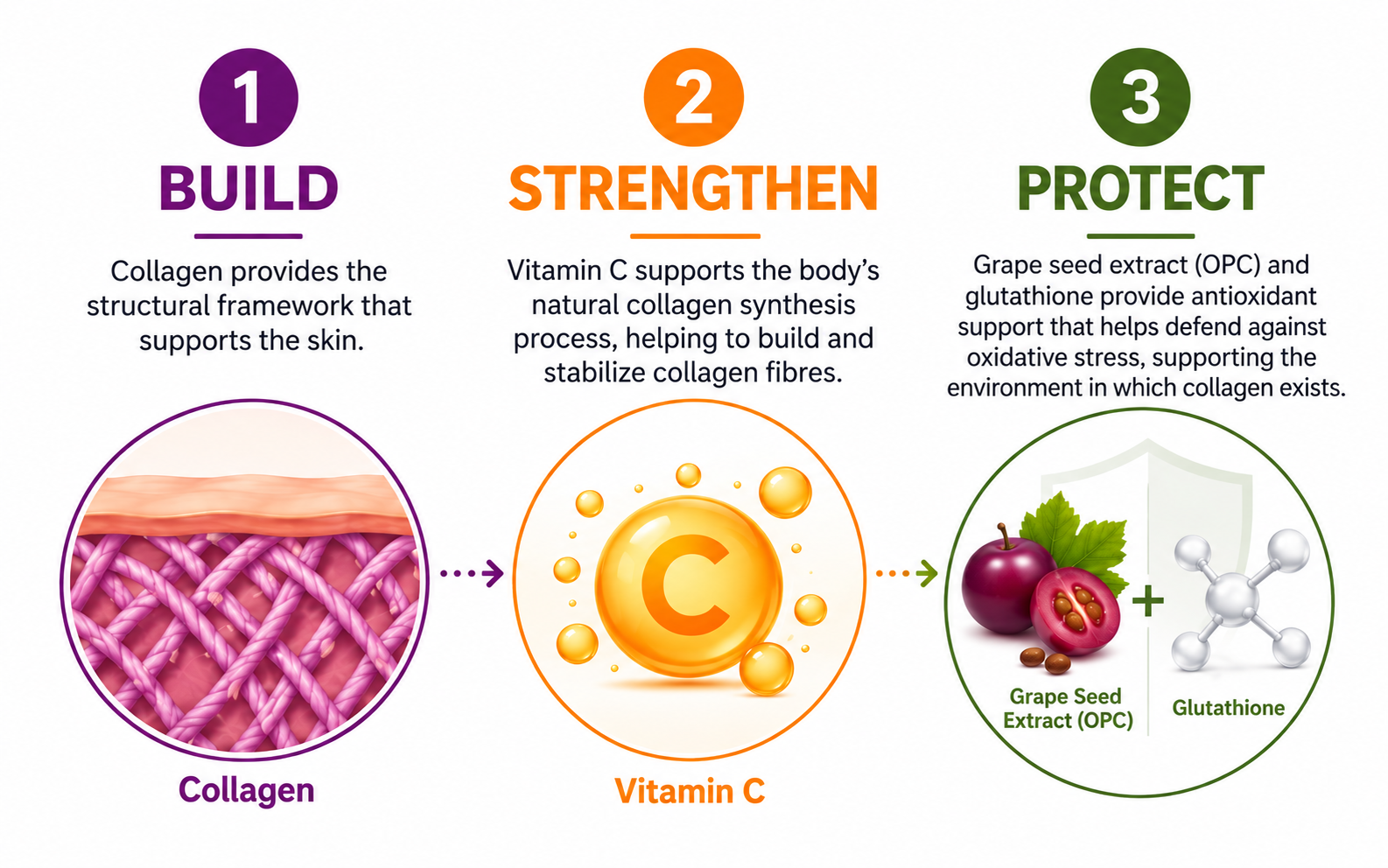
- Collagen provides structural support for the skin, while vitamin C supports normal collagen formation.
- Grape seed extract and glutathione contribute antioxidant support that helps protect against oxidative stress.
- Each nutrient plays a different role, highlighting the importance of a well-rounded approach to long-term skin health. [1]
Conversations around skin health often involve collagen being the first thing that comes to mind. Known as the skin’s “building block,” collagen plays a vital role in maintaining firmness, elasticity, and smoothness. However, one important fact that many consumers may not realize is that collagen does not work alone.
Just as a house needs both bricks and skilled builders, healthy skin requires a combination of nutrients that work together. Among the most important partners for collagen are vitamin C, grape seed extract and glutathione. Each nutrient contributes in its own way to support the skin’s natural structure and resilience.

Most consumers know collagen is important for maintaining firm, supple-looking skin, but do you know that having collagen is only one part of the story? To support healthy skin, the body also needs other nutrients that help build, protect, and maintain collagen.
Think of your skin as a building.
- Build: collagenCollagen forms the framework and supports the beams of the house.
- Strengthen: vitamin CVitamin C helps build and strengthen those beams by supporting collagen production.
- Protect and preserve: antioxidantsGrape seed extract and glutathione help protect the structure from daily wear and tear.
When these work together, you have a stronger structural foundation for long-term skin health.
What does collagen do for skin health?

Collagen is the most abundant protein in our body and acts like a support framework beneath the skin.
It helps provide structure, firmness, and elasticity. When we are younger, our body naturally produces sufficient collagen to keep skin looking smooth and resilient. Unfortunately, collagen production gradually declines with age. Daily exposure to sunlight, pollution, stress, and smoking can also contribute to collagen breakdown over time.
This is one reason why skin needs more than just collagen itself. The body also requires nutrients that support collagen formation and help protect skin from oxidative stress.
How does vitamin C support collagen formation?

Vitamin C plays a critical role in the collagen synthesis process by supporting enzymes that help form and stabilize collagen fibres. Rather than simply being present in the body, collagen must be continuously produced, repaired, and renewed. Vitamin C helps support this ongoing process by enabling normal collagen formation. [2]
Vitamin C ensures collagen molecules are properly structured, allowing them to provide strength and support to the skin and connective tissues. Without sufficient vitamin C, the body is unable to produce collagen efficiently, and newly formed collagen may be weaker and less stable. [2]
Vitamin C also acts as an antioxidant, helping to neutralise free radicals produced through daily exposure to environmental stressors such as UV rays and pollution. [2]
How do grape seed extract and glutathione help protect collagen?


Building a strong structure is important but maintaining that structure is equally important.
Grape seed extract
Grape seed extract contains naturally occurring compounds called oligomeric proanthocyanidins (OPCs), a class of polyphenols known for their antioxidant properties. [3, 4]
These compounds help neutralize free radicals generated by everyday factors such as sunlight, pollution, and stress. [3, 4]
Over time, excessive oxidative stress can affect the skin’s structural proteins, including collagen. Oxidative stress may stimulate enzymes known as matrix metalloproteinases (MMPs), which are involved in the breakdown of collagen within the skin. [4]
Glutathione
Glutathione is often referred to as the body’s “master antioxidant.” It is naturally produced within cells and plays an important role in protecting them from oxidative stress. Glutathione helps neutralize free radicals and supports the body’s antioxidant defence network. [5]
A unique feature of glutathione is that it works closely with other antioxidants, including vitamin C. Vitamin C helps recycle oxidized glutathione back into its active form, while glutathione can also help support the antioxidant activity of vitamin C. This relationship allows both antioxidants to continue functioning efficiently. [5]
When it comes to skin health, it may be time to shift the conversation from “Which nutrient is best?” to “How do nutrients work together?” Collagen, vitamin C, grape seed extract, and glutathione each play distinct yet complementary roles. Rather than working in isolation, they support different aspects of skin structure and protection. Understanding this synergy empowers consumers to appreciate that healthy skin is not built overnight or by a single ingredient, but through a combination of nutrients, healthy lifestyle habits, and consistent self-care over time.
Speak with a CARiNG pharmacist
If you have questions about collagen, vitamin C, grape seed extract or glutathione, a CARiNG pharmacist can help you understand supplement labels, product suitability and when to seek advice from a healthcare professional.
Find your nearest CARiNG Pharmacy →Medical disclaimer: This article is for general health education and does not replace professional medical advice, diagnosis or treatment. If you have concerns about skin health or whether a supplement is suitable for you, speak with a qualified healthcare professional.
Frequently asked questions about collagen and skin health
What does collagen do for the skin?
Collagen acts as a support framework beneath the skin and helps provide structure, firmness and elasticity.
How does vitamin C support collagen?
Vitamin C supports enzymes involved in collagen synthesis and helps enable normal collagen formation. It also acts as an antioxidant that helps neutralise free radicals. [2]
What role do grape seed extract and glutathione play?
Do collagen, vitamin C, grape seed extract and glutathione work independently?
The article’s main message is that these nutrients have distinct but complementary roles in supporting skin structure, collagen formation and antioxidant protection.
View references 6 sources
- CARiNG Pharmacy. Collagen and Skin Health: Build, Strengthen, Protect & Preserve. Original approved source manuscript, Tab 2 (internal editorial document).
- Pullar JM, Carr AC, Vissers MCM. The Roles of Vitamin C in Skin Health. Nutrients. 2017;9(8):866. View source.
- Bagchi D, Bagchi M, Stohs SJ, et al. Free radicals and grape seed proanthocyanidin extract: importance in human health and disease prevention. Toxicology. 2000;148(2-3):187-197. View source.
- Nichols JA, Katiyar SK. Skin photoprotection by natural polyphenols: anti-inflammatory, antioxidant and DNA repair mechanisms. Arch Dermatol Res. 2010;302(2):71-83. View source.
- Wu G, Fang YZ, Yang S, Lupton JR, Turner ND. Glutathione metabolism and its implications for health. J Nutr. 2004;134(3):489-492. View source.
- Proksch E, Schunck M, Zague V, et al. Oral intake of specific bioactive collagen peptides reduces skin wrinkles and increases dermal matrix synthesis. Skin Pharmacol Physiol. 2014;27(3):113-119. View source.